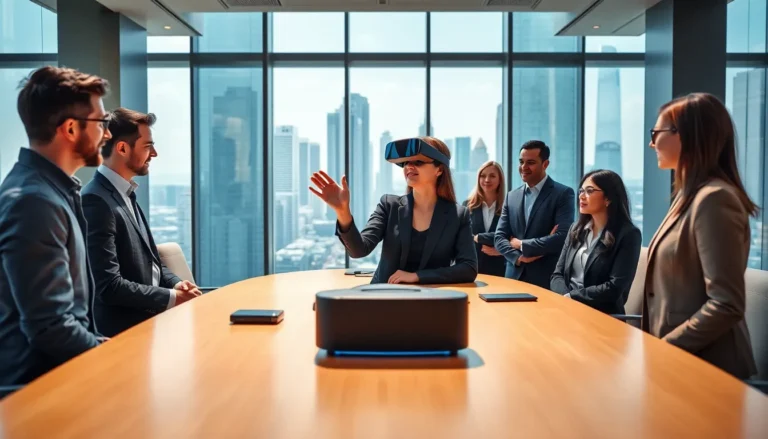
Augmented reality (AR) has rapidly evolved from a niche technology to a transformative force across various industries. With its ability to blend digital elements into the real world, AR is reshaping how people interact with their environment. From gaming to education and retail, the applications are virtually limitless, captivating users and businesses alike.
As advancements in hardware and software continue to emerge, AR is becoming more accessible and sophisticated. Innovations like smart glasses and mobile applications are enhancing user experiences and driving adoption. This article explores the significant progress made in augmented reality, highlighting key developments and future possibilities that promise to redefine the way we perceive and engage with the world around us.
Overview of Augmented Reality
Augmented reality (AR) integrates digital information with the physical world, creating immersive experiences that enhance user interaction. AR technology has advanced tremendously, enabling applications across diverse sectors such as gaming, education, healthcare, and retail.
AR development relies on sophisticated hardware and software solutions. Smart glasses, mobile devices, and AR software platforms increasingly facilitate user access to AR experiences. These innovations enhance visuality and interactivity, allowing users to engage with both digital and real-world elements simultaneously.
Major industry players, including Google and Apple, invest heavily in AR technology. They focus on improving devices, enhancing software capabilities, and refining user interfaces. This investment results in higher-quality experiences and broader adoption of AR solutions in daily life.
The educational sector utilizes AR for interactive learning. Students can visualize complex concepts through 3D models and simulations, increasing comprehension and retention. Similarly, retail businesses use AR to offer virtual try-ons, enabling customers to visualize products before purchasing.
Healthcare benefits from AR through surgical simulations and patient education. Surgeons can overlay critical information onto a patient’s anatomy, improving precision during procedures. AR applications also assist in training medical professionals, enhancing skills through practical, simulated experiences.
Overall, AR’s trajectory indicates a significant potential for future applications. With ongoing advancements, AR is poised to redefine human interaction with digital content, transforming various industries and everyday experiences.
Historical Milestones in Augmented Reality Progress

Augmented reality’s evolution features significant milestones that shaped its current landscape. From early concepts to cutting-edge technology, these developments illustrate AR’s journey.
Early Developments
1968 marked the first AR system, created by Ivan Sutherland, known as the “Sword of Damocles.” This head-mounted display provided basic virtual overlays but required extensive equipment and was impractical for general use. In the 1990s, Boeing used AR in manufacturing to assist with wiring harnesses, improving accuracy and efficiency. The term “augmented reality” emerged in 1992 when Louis Rosenberg developed the Virtual Fixtures system, which enabled AR applications in robotic teleoperation. These foundational efforts paved the way for AR’s transformation into a viable technology.
Major Technological Advancements
2000 saw the introduction of ARToolKit, an open-source library, which simplified the development of AR applications. In 2013, Google Glass brought AR to mainstream attention, showcasing potential in everyday tasks despite facing challenges with public acceptance. The release of Pokémon GO in 2016 marked a pivotal moment, demonstrating AR’s entertainment value and mass appeal. Subsequently, major tech companies, including Apple and Microsoft, released ARKit and HoloLens, further advancing AR’s capabilities. These innovations expanded AR’s presence in industries such as education, gaming, and retail, reflecting its growing influence in digital interaction and user engagement.
Current State of Augmented Reality
Augmented reality (AR) technology continues to advance rapidly, impacting numerous sectors and enhancing how users interact with digital content. Current developments underscore AR’s growing significance across different industries, driving innovative applications and improving user experiences.
Key Applications in Various Industries
- Gaming: AR transforms gaming by creating interactive experiences that blend virtual characters and environments with the real world. Titles like Pokémon GO and Pokémon Sleep illustrate AR’s capacity to captivate users while encouraging physical activity.
- Education: AR enhances learning by visualizing abstract concepts. Applications such as Google Expeditions allow students to explore historical events and scientific phenomena through immersive 3D environments, thus improving retention and engagement.
- Healthcare: AR aids medical professionals by overlaying vital information during procedures. Systems like Microsoft HoloLens assist surgeons with real-time data and visualizations that enhance precision, while applications for medical training provide students with lifelike scenarios in a controlled setting.
- Retail: AR revolutionizes shopping experiences through virtual try-ons. Companies like IKEA and Sephora implement AR technology, allowing customers to visualize furniture in their homes or makeup on their faces, thus reducing return rates and increasing customer satisfaction.
- Manufacturing: AR tools guide assembly processes and maintenance. Companies such as Boeing utilize AR to project assembly instructions onto workspaces, improving efficiency and reducing errors during production.
Impact on User Experience
- Enhanced Engagement: AR technology fosters deeper user engagement by creating immersive environments. Users interact with content more meaningfully, leading to higher satisfaction and prolonged interaction times.
- Increased Accessibility: AR broadens access to information. By overlaying useful data on physical objects, AR simplifies complex tasks for users, making it easier to understand and navigate various concepts.
- Personalization: AR delivers tailored experiences. Users receive content based on individual preferences and environments, enhancing relevance and creating a more personal connection with the material.
- Improved Retention: AR’s interactive nature boosts information retention. Users are more likely to remember concepts presented in an engaging format, making it an effective tool for education and training.
- Real-Time Feedback: AR offers immediate responses to user actions. This instant interaction promotes a dynamic learning process, essential for industries that rely on rapid adjustments based on user input.
Future Trends in Augmented Reality
Augmented reality (AR) is set to evolve rapidly, influenced by emerging technologies and significant market growth predictions. These trends promise to redefine its applications across various industries.
Emerging Technologies
Emerging technologies such as artificial intelligence (AI), 5G, and advanced computer vision are shaping the future of AR.
- AI Integration: AI enhances AR by enabling real-time recognition of objects, improving user interactions, and personalizing experiences. Advanced algorithms can analyze user behavior, leading to tailored content that increases engagement.
- 5G Networks: 5G technology facilitates faster data transmission and lower latency, enhancing AR experiences. Richer content can be delivered seamlessly, allowing for multi-user interactions in real time.
- Computer Vision: Improved computer vision enables more accurate tracking and mapping of environments. This technology allows AR applications to understand spatial contexts, creating more immersive experiences.
Predictions for Market Growth
Predictions indicate that the AR market will continue its exponential growth in the coming years.
- Market Value: The global augmented reality market is projected to exceed $198 billion by 2025, driven by increased adoption across sectors like gaming, retail, and healthcare.
- User Adoption Rates: Adoption rates among businesses are expected to rise, with over 70% of companies planning to implement AR solutions to enhance customer engagement and operational efficiency.
- Consumer Demand: As consumer demand for immersive experiences grows, industries will likely increase investment in AR technology, fostering innovation and expanding use cases from marketing to training solutions.
These trends in emerging technologies and market growth highlight the potential of AR to transform interactions with the digital world.
The journey of augmented reality has been nothing short of remarkable. As it continues to evolve and integrate into everyday life, its potential to reshape industries is becoming clearer. The investment from major tech players signifies a strong belief in AR’s future impact on user engagement and operational efficiency.
With advancements in AI, 5G, and computer vision, AR is set to deliver even more immersive experiences. As consumer demand for innovative technology grows, businesses are likely to adopt AR solutions at an increasing rate. This transformative technology is not just enhancing how people interact with digital content; it’s paving the way for a new era of connectivity and creativity.